

The Missing 13th Amendment
Titles of Nobility, Honor, and other things we seem to have forgotten about.

In the winter of ‘83, when America was worried about nuclear war, shoulder pads, and whether Reagan was secretly a cowboy, two men were quietly rummaging through old books in a library on the coast of Maine.
David Dodge, an archival researcher, and Tom Dunn, a former Baltimore police investigator, were not looking for constitutional heresy. They were looking for corruption. What they found instead was worse.
In the Belfast Library, they uncovered an 1825 printing of the United States Constitution. An authentic one, not a souvenir version with bald eagles and inspirational fonts. And sitting there, minding its own business, was something modern Americans are assured never existed:
A Thirteenth Amendment that does not appear in today’s Constitution.
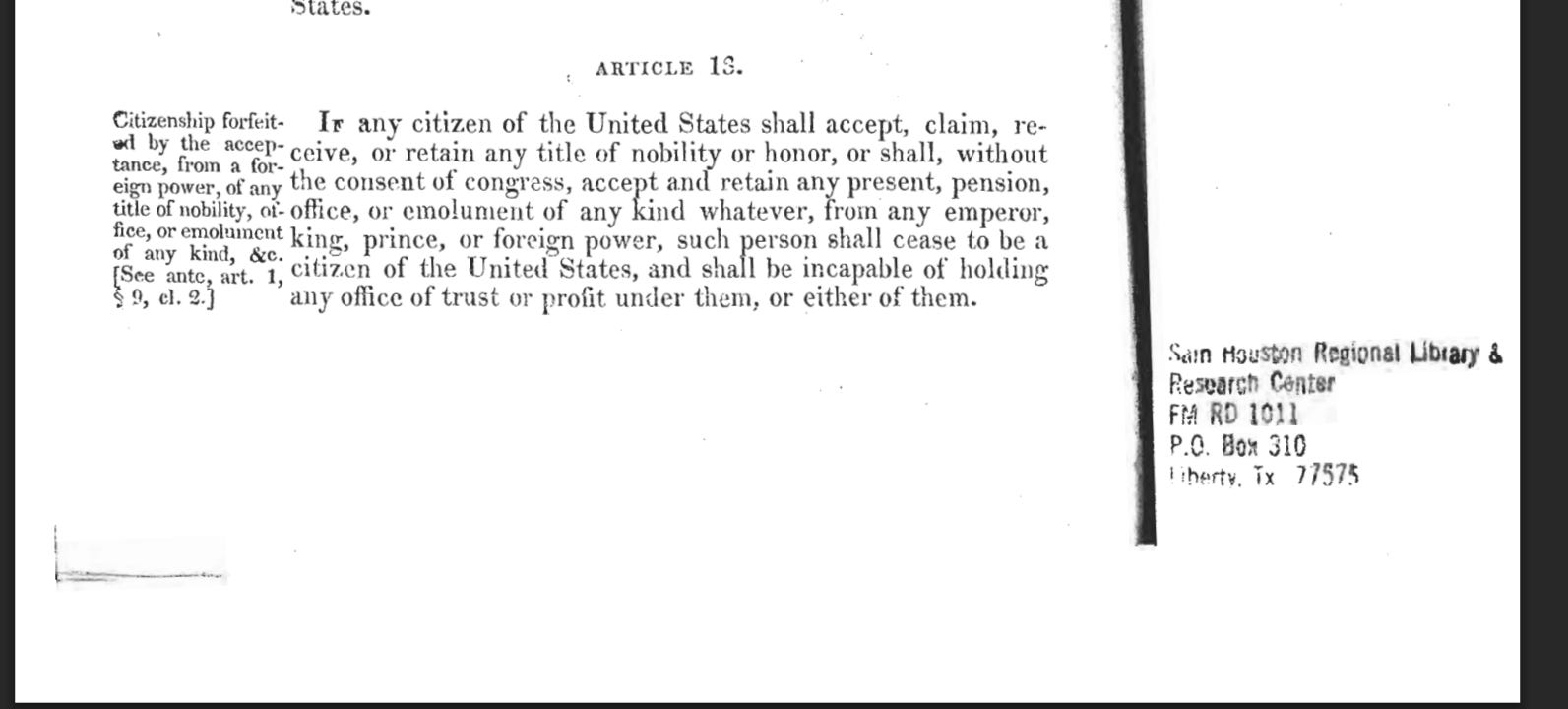
Even stranger, this amendment wasn’t about slavery. It wasn’t symbolic. It wasn’t obscure trivia. It was blunt, surgical, and wildly inconvenient.
It appeared to ban lawyers from holding public office.
That discovery kicked off a seven-year, nationwide investigation into what may be the most awkward constitutional mystery in American history: the quiet disappearance of a ratified amendment. Since then, Dodge and Dunn have identified at least eighteen printed Constitutions, from ten states and territories, published between 1822 and 1860, all containing this “missing” amendment.
In 1991, Dodge located evidence1 indicating the amendment had been lawfully ratified by Virginia in 1819. If the records are accurate, and no one has successfully disproven them, then an amendment stripping citizenship from anyone who accepted a “title of nobility or honor” was once the law of the land.
And unless it was properly repealed (it wasn’t), it still is.
Which is… awkward.
WHAT THE “MISSING” AMENDMENT ACTUALLY SAYS
Here’s the text, minus the powdered wigs:
“If any citizen of the United States shall accept, claim, receive, or retain any title of nobility or honour… from any emperor, king, prince, or foreign power, such person shall cease to be a citizen of the United States, and shall be incapable of holding any office of trust or profit under them.”
At first glance, this sounds like post-Revolution petty revenge. No dukes, no counts, no Sir Fancy Pants allowed. In the age of People Magazine royalty coverage, it’s tempting to dismiss the whole thing as antique paranoia.
That would be a mistake.
Because the Founders were obsessed with this problem.
They banned titles of nobility in the Articles of Confederation. They banned them again in the Constitution. Then they tried to ban them again, twice, via amendment. You don’t keep reinstalling the same lock unless someone keeps trying to break into the house.
Whatever this amendment was aimed at, it wasn’t symbolic. It was defensive.
WHY DEMOCRACY SCARED THE HELL OUT OF EUROPE
Today, “democracy” is a bumper sticker word. In the 18th century, it was considered a contagious disease.
European monarchies viewed the American Revolution the way Cold War governments viewed communism: unnatural, godless, and likely to spread. And it did.
France revolted. Poland revolted. The American experiment became a glowing billboard advertising the overthrow of kings.
Even after the war officially ended in 1783, the United States didn’t stop being dangerous. Our existence alone undermined every throne in Europe. If the infection could be neutralized at the source, perhaps the monarchies could survive.
Military invasion failed. So they tried something subtler.
Money.
Law.
Influence.
The first cold war wasn’t fought with missiles. It was fought with banks, lawyers, and treaties written in polite handwriting.
BANKS: A VERY OLD MAGIC TRICK
Sir Josiah Stamp, former head of the Bank of England, once explained modern banking with remarkable honesty:
“Banking was conceived in inequity and born in sin… Take away the bankers’ power to create money, and all great fortunes like mine would disappear.”
Translation: We print money, buy your stuff, then charge you interest for the privilege.
Colonial Americans knew this scam well. European goldsmith banks issued paper claims to gold they didn’t have, inflated the money supply, caused bank runs, and left citizens holding worthless paper while bankers walked away rich, or occasionally got hanged. (A practice we inexplicably discontinued.)
Paper money during the Revolution collapsed so badly it took 1,000 bills to buy one coin. The phrase “not worth a Continental” wasn’t poetic, it was accounting.
This is why the Constitution insists states use gold and silver. Not to protect the wealthy, but to prevent money from reproducing itself like a bacterial infection.
SUBVERSION, NOT INCOMPETENCE
Consider this small mystery: In 1794, via the Jay Treaty, the United States quietly agreed to pay 600,000 pounds sterling to King George III.
Yes. The king we had just defeated.
The treaty was ratified in secret. Congress ordered it not published. When Benjamin Franklin’s grandson leaked it anyway, Congress responded by passing the Alien and Sedition Acts to criminalize journalists.
That’s not confusion. That’s panic.
Then there was the First Bank of the United States. Eighty percent foreign-owned. Authorized to lend double its capital2. By 1796, the U.S. government owed the bank millions and had to sell its shares. By 1811, European investors pulled out seven million in specie, crashed the economy, and helped trigger the War of 1812.
This isn’t conspiracy theory. It’s documented leverage.
SO WHERE DO LAWYERS COME IN?
When bankers commit fraud, they don’t hire thugs. They hire lawyers.
In Europe, bankers and lawyers formed durable alliances, laundering criminal behavior into respectability. Eventually, the Crown rewarded them with legitimacy, titles of nobility.
“Esquire” wasn’t a flourish. It was a rank.
In colonial America, there were no mandatory bar associations. No requirement that judges or prosecutors be lawyers. Your counsel didn’t need credentials from a foreign guild.
The exception? The International Bar Association, chartered by the King of England, headquartered in London, and closely aligned with international banking interests.
Membership came with a title: Esquire. Which is precisely the title this amendment targeted.
“HONOR”: THE REAL SMOKING GUN
The amendment doesn’t just ban titles. It bans honors.
At the time, “honor” meant a special privilege, an advantage not available to everyone else.
Sound familiar?
Judicial immunity.
Qualified immunity.
Legislative privilege.
Special exemptions.
Regulatory carve-outs.
“Special interests” (which is just marketing for “special privileges”).
If this amendment means what it says, then anyone enjoying a legal privilege unavailable to ordinary citizens is violating its spirit and possibly its letter.
Which may explain why this amendment is missing.
WHAT IF?
What if the Founders weren’t naïve?
What if they anticipated financial capture?
What if they saw lawyers and bankers as vectors of foreign influence?
What if the amendment didn’t vanish by accident?
And what if the real scandal isn’t that this amendment existed…
…but that we stopped talking about it?

https://unmasker4maine.wordpress.com/wp-content/uploads/2013/09/constitution-_-original-constitution_of_the_united_states-1.pdf
Which seems stable compared to our current fractional reserve banking system